Every service rendered counts! With Bonder, every step in the service process is transparently documented, so no effort is lost and all services can be reliably billed.
Customer inquiries often involve many processing steps, with various employees, departments, or external partners involved. To ensure that nothing gets lost, Bonder documents Bonder services in detail, comprehensively, and without gaps. This creates a clear basis for not only transparently tracking services rendered, but also for billing them promptly and completely.
Below you will find all the functions and options that Bonder to enable comprehensive and accurate billing.
- Complete history—the foundation for efficient work
- Quality assurance and knowledge management
- Legal and compliance requirements
- Long-term strategic advantage
- Bonder as the foundation for transparent and comprehensively documented billing
- Complete communication documentation
- Record services
- Tasks document sub-steps
- Service Level Agreements
- Lifetime records of involved products
- Extract and document knowledge
- Frequently Asked Questions
- Conclusion
Complete history—the foundation for efficient work
Every customer ticket is a little story: from the initial inquiry to the final solution.
When every step, every communication, and every decision is clearly recorded, a complete history is created that can be traced at any time.
This has several advantages
-
Faster onboarding of new staff
If the contact person in the service department changes, the successor can immediately grasp the context without having to ask the customer for all the information again. -
Avoiding duplication of work
Repeated analyses or unnecessary tests are prevented because steps that have already been taken are clearly documented. -
Shorter processing times
Less time wasted "searching for" information.
Quality assurance and knowledge management
Well-maintained customer tickets are more than just case files—they are a valuable source of knowledge.
-
Analysis of recurring issues
Patterns can only be identified when data is complete. This helps with product improvements and error prevention. -
Training new employees
Real ticket histories serve as practical examples for training purposes. -
Self-service portals
Fully documented solutions can be transferred to knowledge databases and help customers solve problems themselves.
Legal and compliance requirements
In regulated industries such as financial services, healthcare, or manufacturing, complete documentation is not only best practice, but often a legal requirement.
-
Audit security
Authorities or certification bodies may request access at any time. -
Evidence documentation
In the event of disputes, a complete history serves as an objective basis. -
Risk minimization
Clear documentation protects against liability claims.
Long-term strategic advantage
The information from the documented inquiries can be further processed in various areas of the company.
-
Better product development
Feedback from tickets is incorporated into further development in a structured manner. -
Brand strengthening
Reliable, transparent customer service leaves a lasting positive impression. -
Efficiency gains in daily operations
Less searching, fewer misunderstandings, clearer communication.
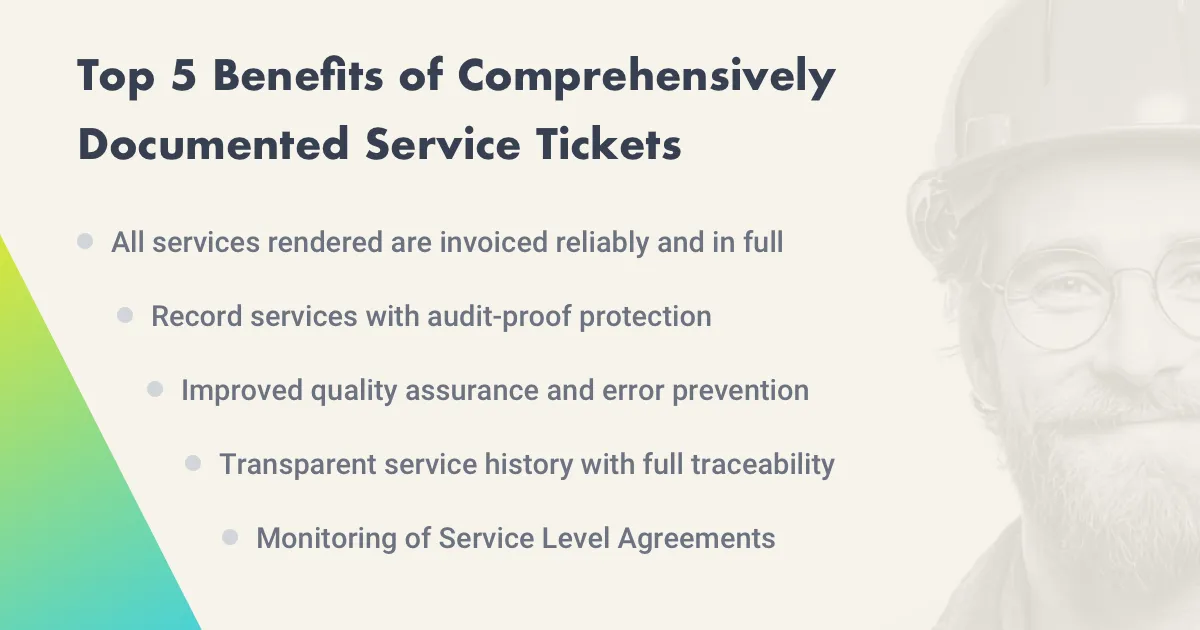
Bonder as the foundation for transparent and comprehensively documented billing
Bonder are much more than just the organizational hub for all customer inquiries: they ensure that all services are documented objectively and immutably!
In addition to smooth processing and quality assurance, documented service processes also offer the particular advantage of loss-free billing: no activity goes unrecorded, and every relevant service is made available for invoicing. This enables companies to achieve maximum transparency, protect their revenues, and optimize both service quality and economic success.
Here are a few examples of how Bonder supports comprehensive Bonder and billing.
Complete communication documentation
Each Bonder has multiple communication channels that document every exchange of information.
-
User groups per channel
Each channel can contain specific person groups. For example, "End customer," "Internal," or "Supplier." -
Various integrations
Chat messages, emails, and even data from third-party systems such as telephone systems or VoIP telephony are recorded in the communication channel. -
Communication history
All information is sorted chronologically and ticket events are added as needed (e.g., status changes or changes to contact persons).
Record services
Every service associated with the ticket can be documented Bonder in the ticket in Bonder .
-
Documentation of services
Each ticket has a service log in which working hours or resources and products used are entered. These can be transferred directly to the invoice. -
Available everywhere
The performance log can also beSmart Service App on the go in the Bonder Smart Service App , allowing field service technicians to document immediately and seamlessly. -
Integrations
Third-party systems can automatically log services via the Bonder or the API.
Tasks document sub-steps
A customer inquiry often cannot be answered in a single step. The response may require the involvement of different people or even more complex tasks. Tasks not only organize these sub-steps, but also document them.
-
Manage sub-steps
Tasks are used to document sub-tasks assigned to other employees. -
Reminders
Time elapsed is monitored and exceeded times are reported. -
Planning
Tasks can interact with customers and are used to document all customer appointments (on-site and online).
Service Level Agreements (SLA)
Customers with service level agreements (SLAs) have special documentation requirements. Time sequences must be recorded and tracked in real time. At the end, it must be clear whether the SLA has been complied with.
-
Integration into tickets
When a ticket is assigned to an SLA, every relevant status change or SLA phase is logged. -
Define SLA parameters
SLAs are documented in contracts. -
Visualization
The status of the ticket can be seen via the time bar.
Lifetime records of involved products
A Bonder also integrates the affected products or systems. The history function (life file) ensures that all customer inquiries about the product or Installations are Installations .
-
Automatic entries
Bonder automatically Bonder all requests and links the corresponding tickets. -
Manual entries
Employees can manually document events (including videos or photos). This option is also available to field service personnel on site. -
Integrations
Third-party systems can write directly to the life record via the Bonder or API. This can begin during production or include runtime data such as important IoT information.
Extract and document knowledge
Bonder modern AI capabilities to extract information from customer inquiries and convert it into lasting knowledge.
-
Knowledge extraction
A ticket is checked using AI and a summary is transferred to a Bonder . -
Document knowledge
Bonder document what has been learned from customer inquiries in order to provide this information to service employees for faster processing. -
Leverage knowledge
Knowledge elements are fed into an AI and can be queried interactively. Upon request, the knowledge can also be made available directly to customers.
Frequently Asked Questions
Conclusion
Comprehensively documented customer inquiries not only form the basis for quick solutions and satisfied customers, but are also crucial for complete and transparent billing of all services rendered. Those who comprehensively Bonder their service processes with Bonder prevent losses in billing and strengthen the cost-effectiveness of customer service.