
Many service tickets describe an error. Viewed individually, it is a problem that needs to be solved. Viewed in the aggregate, it is a data point—one of many that, together with others, reveals a pattern. Those who fail to see these patterns are merely treating the symptoms. Those who recognize them eliminate the root causes. This is exactly what error clustering in Bonder makes possible.
Many service teams work hard—but not necessarily on the right problem. They handle ticket after ticket, resolving each one reliably, and yet the same type of error resurfaces the following week. And the week after that. Not because the team is doing a poor job, but because no one is connecting the dots between the individual incidents.
Without a structured analysis, the question remains unanswered: Why do the same errors keep occurring? Is it the product? The installation process? Customer training? Or is it seasonal wear and tear that could be predicted?
Error clustering in Bonder the answers —by turning the flood of tickets into meaningful insights.
What is error clustering—and why isn’t simple categorization enough?
Error clustering allows you to assign each service interaction to one or more custom error categories. You define these categories yourself—tailored to your industry, your products, and your typical problem areas.
At first glance, this sounds like a simple categorization. But the real value only becomes apparent when tickets are consistently categorized over weeks and months: this results in structured error statistics that reveal what was previously invisible.
A simple categorization labels a process. Error clustering, on the other hand, builds a picture over time: Which error categories account for the majority of cases? Where are clusters increasing? What is an isolated incident, and what is a pattern? These questions cannot be answered without structured analysis data—no matter how experienced your team is.
How error clustering Bonder in Bonder
In Bonder , you Bonder up error categories once—as many and as specific as make sense for your business. When processing a ticket, your employees assign the issue to one or more of these categories. We’ve kept this step intentionally simple!
What happens next is key: Bonder these classifications across all tickets and immediately highlights clusters in the dashboard. You can see at a glance which error categories are particularly prevalent—and how this changes over time.
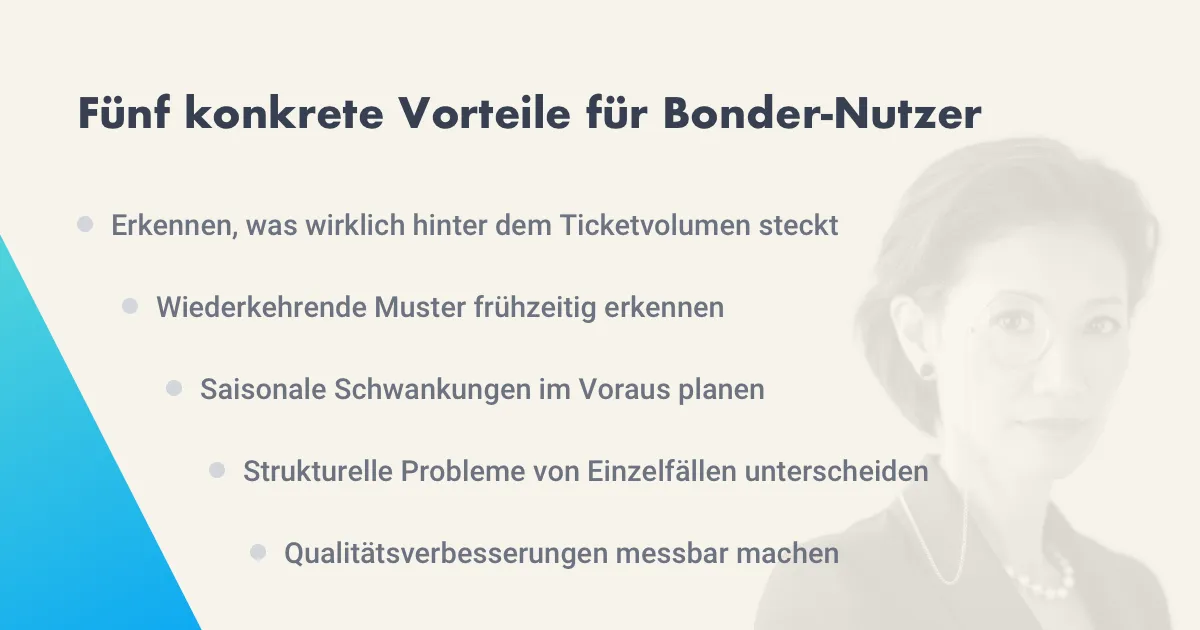
Five concrete benefits for Bonder users
Understanding what really lies behind ticket sales
Many service teams know they have a lot of tickets—but they don’t know why. Error clustering reveals which types of errors account for the majority of the volume. Are they user errors? Wear-and-tear issues? Installation errors? Once you know, you can take targeted action—no longer a one-size-fits-all approach, but a precise, focused response.
Recognizing recurring patterns early on
If the same type of error keeps cropping up, it’s no coincidence—it’s a warning sign. Bonder immediatelyBonder such patterns in the dashboard: You can see at a glance if a particular error category has increased disproportionately in recent weeks. And you can take action before it becomes a real problem.
Plan for seasonal fluctuations in advance
Certain types of faults tend to occur more frequently during specific seasons: heating system failures in the fall, air conditioning problems in the summer, and software errors following updates. By recognizing these patterns in historical data, you can plan for resources and spare parts in advance—rather than being caught off guard every year.
Distinguish between structural problems and individual cases
Not every ticket is a sign of an underlying problem. But if 30% of all tickets fall into the same error category, that’s no longer an isolated incident— it’s a structural issue that deserves attention. Error clustering helps you recognize this distinction and set the right priorities.
Making quality improvements measurable
You’ve created a training video, changed a process, or introduced new replacement parts. Did it help? With error clustering, you can see in the analysis whether the affected category generates fewer tickets afterward. This means quality measures aren’t just perceived as effective—they become measurable.
Address the root causes rather than treat the symptoms
Join us for a personalized demo to see how Bonder error clustering Bonder turn your service tickets into actionable insights—and how you can finally make quality initiatives measurable.
Two real-world scenarios
Scenario A: From a reactive approach to a preventive approach
A service provider for industrial machinery uses fault clustering to determine that 38% of all service tickets fall under the category of “wear and tear on drive components.” This insight leads to a concrete decision: Customers with specific machine types will now receive proactive reminders about maintenance intervals—before wear and tear leads to a breakdown. The number of service tickets in this category drops by more than a quarter within a single quarter.
Scenario B: Identifying training needs before they affect the CSAT score
Another company realized that a large portion of its support tickets fell under the category of “user error.” Without error clustering, this pattern would have been lost in the general noise of support tickets. The analysis made the necessary actions clear: a revamped onboarding process for new customers and a short training video addressing common user errors. The result: a 20% reduction in tickets in this category within three months.
Define it yourself – control it yourself
The key advantage of error clustering in Bonder its flexibility: you define the categories yourself, tailored to your company, your products, and your industry. There is no predefined category system that doesn’t fit your business.
Error categories can be customized, expanded, or renamed at any time—and new categories can also be applied to existing tickets. The system grows with your business and with the knowledge you gain about your typical error patterns.
The result: Not a straitjacket, but a tool. One that turns your service data into actionable insights.
Frequently Asked Questions
Conclusion
Simply issuing individual tickets isn’t enough to truly manage a service operation. Only when you analyze the volume of processes in a structured way do the patterns underlying recurring problems become apparent. Error clustering in Bonder exactly that possible—without any IT effort, without programming knowledge, and with insights you can use right away.
By consistently tracking areas prone to errors, you will eventually build up error statistics that serve as a valuable management tool for quality assurance, resource planning, training needs, and proactive maintenance. Addressing the root causes rather than treating the symptoms—that is the difference between reactive and proactive service management.
Why You Should Bonder
If you’ve realized that structured error analysis is the key to proactive service operations—then Bonder is Bonder next logical step.
Schedule a free 30-minute demo call today and see firsthand how error clustering in Bonder can transform Bonder service operations.
- How to Define Tolerance Ranges Yourself – Tailored to Your Industry and Products
- How error clustering reveals patterns in your service data that were previously hidden
- How to identify recurring types of errors early on and take targeted corrective action
- How to make quality measures quantifiable and see their impact directly in the analysis